

Public talk by Joshua Decter
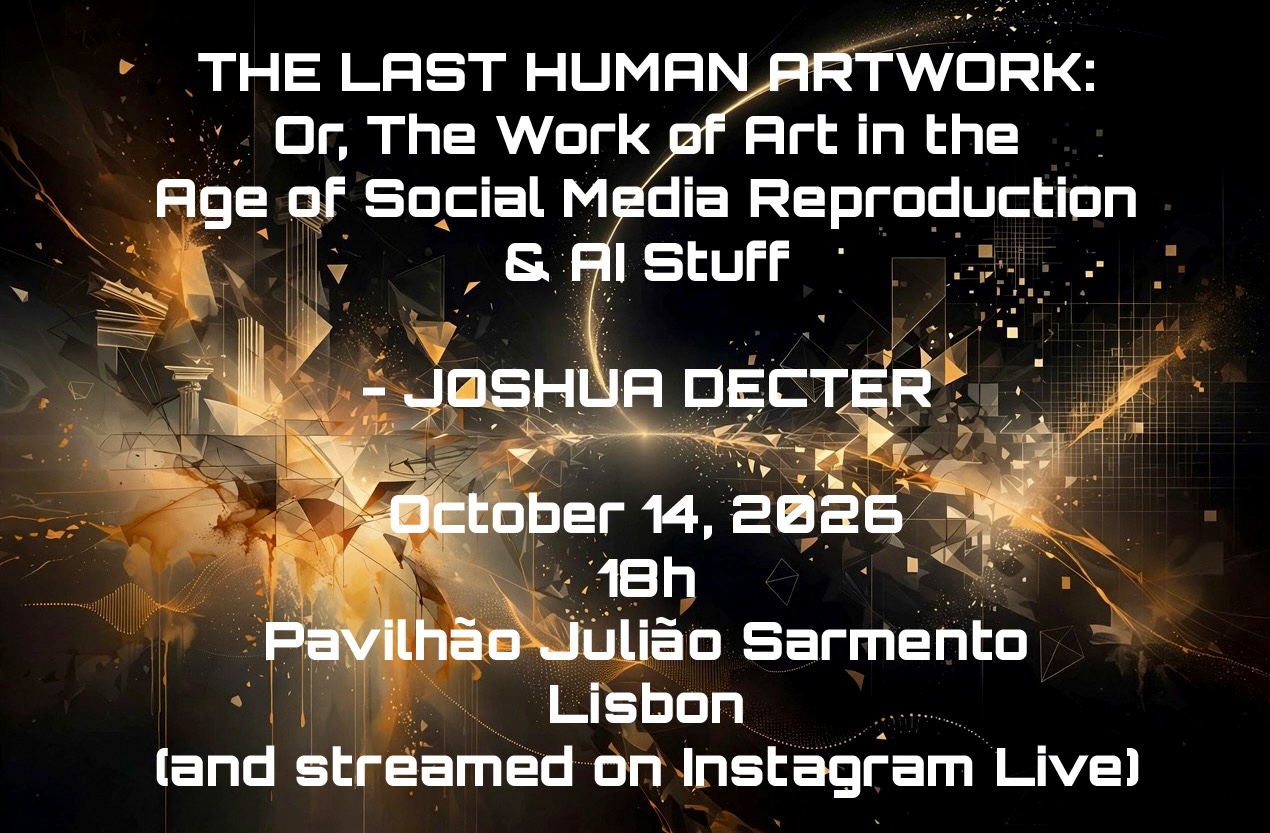
October, 14
6pm
THE LAST HUMAN ARTWORK:
Or, The Work of Art in the Age of Social Media & AI Stuff
How to imagine a revisionist art history in relation to how art has been recontextualized, decontextualized, endlessly reproduced, and hyper-mediated via the circuits of social media? Some have argued that the internet, in its entirety, can be considered a type of collective human (or posthuman) meta-art.
Is social media a medium for art? Has AI ushered in an age of radical democratization of art, wherein anyone using AI can instantaneously become an artist?
Can we consider AI slop as a new genre of art, or is it just AI slop? Who decides? Who are the cultural gatekeepers – and gatecrashers – in the age of AI? What will the last human artwork look like once AI becomes the “superartist”?
Duration: 45 minutes + 15 min Q&A
Time: 6 pm
Please note that attending the talks requires a valid admission ticket. For ticket information please visit the Pavilhão Julião Sarmento website.
Pavilhão Julião Sarmento: Av. da Índia 172, 1400-207 Lisbon
Joshua Decter is a writer, curator, and art historian whose books include Art Is a Problem: Selected Criticism, Essays, Interviews and Curatorial Projects (1986-2012) published by JRP|Ringier in 2014, and Exhibition as Social Intervention: Culture in Action 1993, published by Afterall Books, also in 2014. Decter writes for Artforum, and has contributed to Art Review, Mousse, Umbigo, Texte zur Kunst, among other journals and magazines. He has authored exhibition catalogue essays for numerous artists since the late 1980s, including Catherine Opie, General Idea, On Kawara, Mel Chin, Monica Bonvicini, Rirkrit Tiravanija, Fred Wilson, Keith Haring, Joan Jonas, Anton Vidokle, Isa Genzken, Luisa Cunha, Jonathan Horowitz, Rick Lowe/Project Row Houses, and Amy Sillman.
His book Art Is a Problem encompasses seven chapters: Institutional Critique® and its Discontents; Aporia (art as politics, the politics of art); Everything is Social; Convoluted Cities; The (Un)De-definition of Art; What do we want from exhibitions?; On the Curatorial Road. By bringing together a selection of older and newer writings, Decter considers art’s paradoxical condition as both a historical and contemporary condition: i.e., art problematizes things, but it also has intrinsic problems. From this standpoint, Decter analyzes art’s various definitions, redefinitions, and functions; its ethical entanglements; its societal aspirations; and its cultural contradictions. The book considers examples of historical and contemporary art, architecture & urbanism, the interrelationship between museums and the critique of institutions, and curating considered as a language/practice that demands rethinking— in relation to various ideological, public, discursive, and social milieus. His other book, Exhibition as Social Intervention, is a deep dive into Mary Jane Jacob’s groundbreaking 1993 exhibition, ‘Culture in Action,’ which was a key moment in the rethinking of traditional museum curation and the conventions of public art. The book examines how this exhibition project – which took place within various urban sites throughout Chicago – helped to accelerate the transition from traditional notions of art in public space towards socially-engaged art and social practice.
Decter has curated exhibitions at PS1 (MoMA PS1), The Museum of Contemporary Art in Chicago, the Center for Curatorial Studies Museum at Bard College, the Kunsthalle Vienna, Friedrich Petzel Gallery, and Apex Art.
He has taught art history, art theory, curating, and exhibition histories at the University of Applied Arts in Vienna, the School of Visual Arts in NYC, The University of Southern California in Los Angeles, The Cooper Union in NYC, Bennington College in Vermont, The Center for Curatorial Studies at Bard College, The School of the Art Institute of Chicago, New York University, UCLA, and Art Center College of Design in Pasadena. He attended the Whitney Museum’s Independent Study Program in 1984-1985.